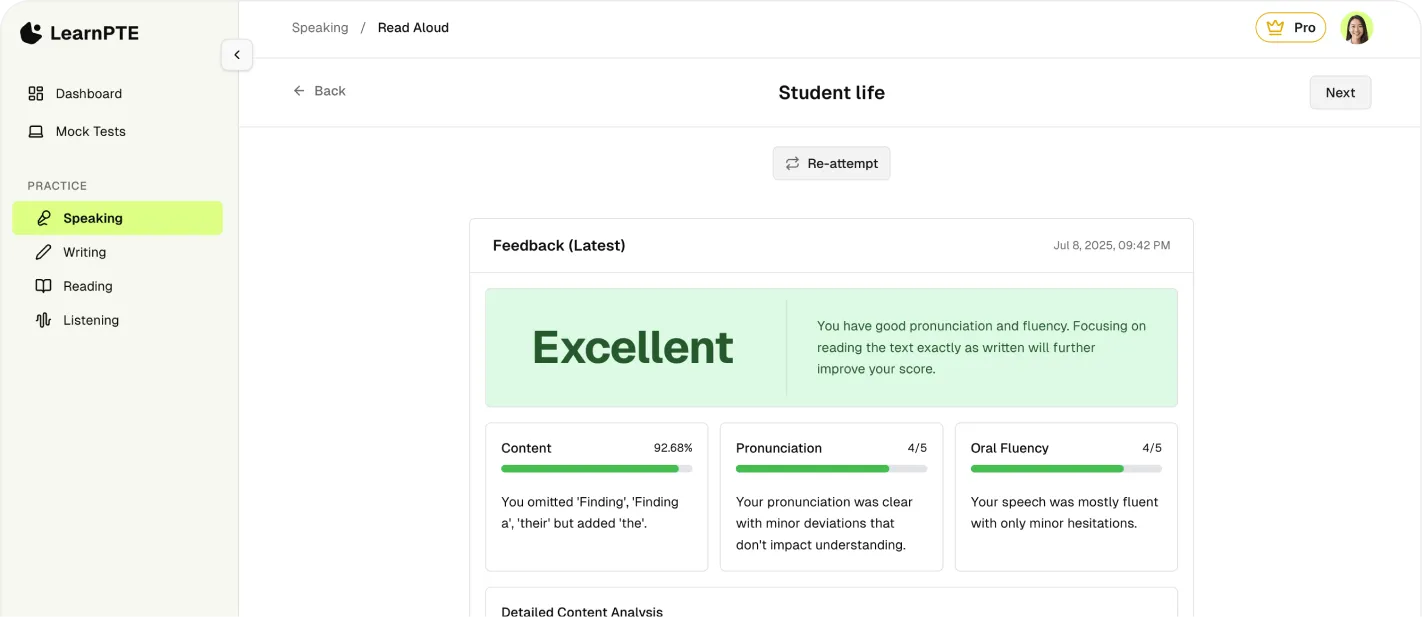
When practicing PTE speaking tasks, you receive a pronunciation score, but understanding what you actually mispronounced can be challenging. Was it the vowel sounds? Consonants? Word stress? Identifying the specific issue is necessary for improvement.
Why pronunciation feedback matters for your PTE Score
Pronunciation contributes to your PTE speaking score across all speaking tasks—Read Aloud, Repeat Sentence, Describe Image, Retell Lecture, and others. The difference between score bands often comes down to consistent pronunciation errors that test-takers may not realize they're making.
Without specific feedback, you might reinforce incorrect pronunciation patterns, repeating the same vowel errors or stress mistakes in each practice session. Generic feedback like "work on your pronunciation" doesn't indicate what specifically needs attention.
How phoneme-level feedback works
Phoneme error detection analyzes your speaking responses at the individual sound unit (phoneme) level. The feedback includes:
- Mispronounced words highlighted in color-coded categories
- Error type identification: vowel sounds, consonants, word stress, or unclear pronunciation
- Audio playback of the correct pronunciation for any word
- Error tracking across specific categories over time
- Focused practice areas based on your actual patterns
Understanding the feedback
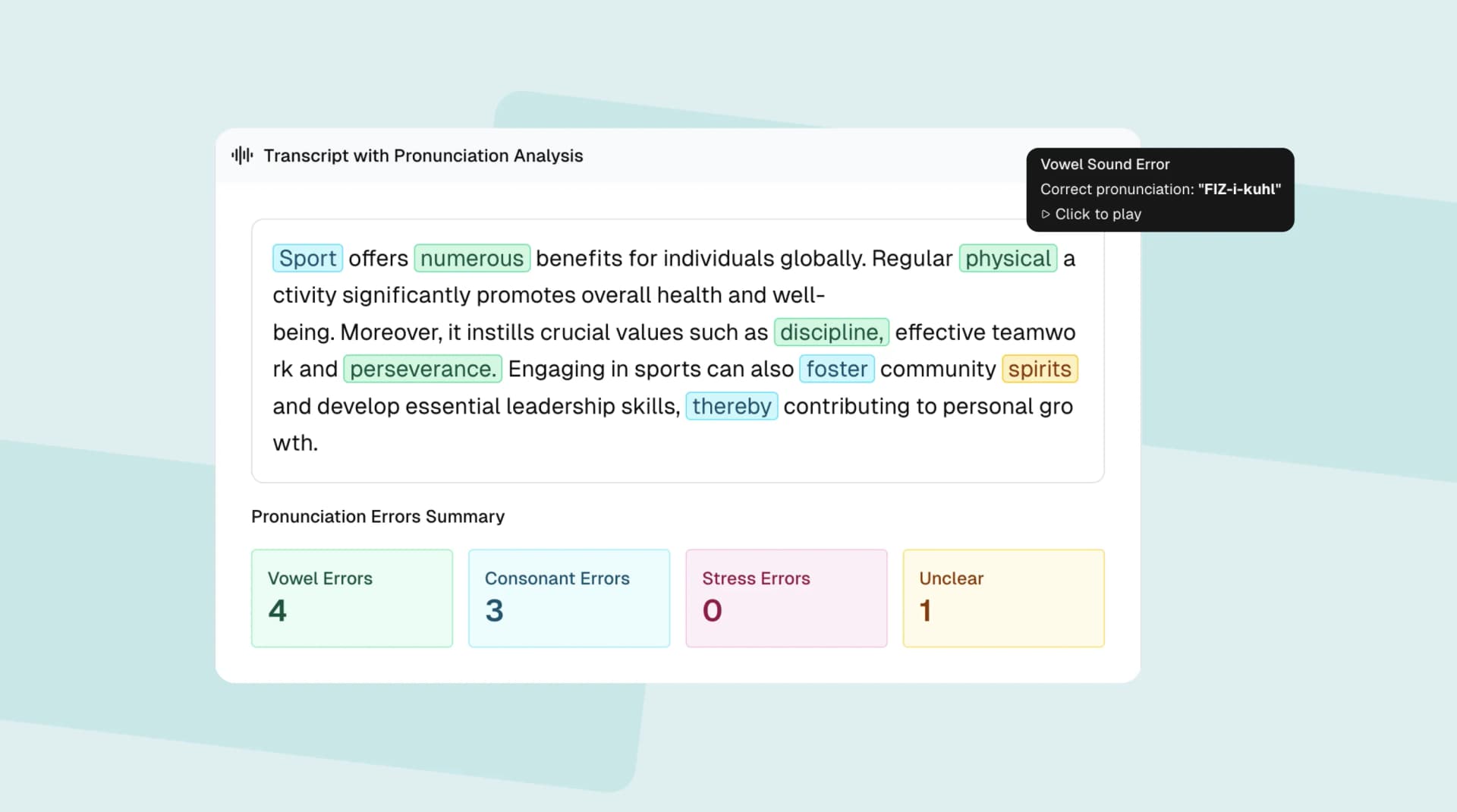
After completing a speaking task, the feedback includes an interactive transcript that highlights pronunciation errors:
- Emerald green: Vowel sound errors (e.g., saying "bit" when you meant "beat")
- Cyan blue: Consonant errors (e.g., "th" sounds, "r" vs "l" confusion)
- Pink: Word stress errors (e.g., stressing the wrong syllable in "photograph")
- Amber yellow: Unclear or mumbled pronunciation
Hovering over a highlighted word shows the expected pronunciation versus what was detected. Clicking the word plays the correct pronunciation.
The feedback includes a breakdown of error counts by category: vowel errors, consonant errors, stress errors, and unclear words. This data helps identify areas that need attention.
Using the feedback effectively
Research on pronunciation improvement emphasizes the importance of specific, actionable feedback. Knowing which sounds need work is more effective than general practice recommendations.
Phoneme error detection provides measurable data. You can track specific metrics over time, such as reducing vowel errors from 12 per passage to 5, which indicates concrete progress.
Recommended practice approach
- Review the color-coded transcript and identify recurring patterns
- Listen to correct pronunciations of highlighted words and practice them
- Focus on one error category at a time—for example, if you have many vowel errors, work on those specific vowel sounds
- Re-record the same passage to compare error counts
- Note recurring errors to address them systematically
- Review the improvement suggestions provided with your feedback
Connection to PTE scoring
This feedback aligns with PTE's pronunciation scoring criteria, which evaluates how closely your speech approximates standard English pronunciation. Phoneme errors—whether vowel, consonant, or stress-related—affect your score.
Identifying and addressing specific pronunciation patterns helps target the areas that impact your score, regardless of your target band.