Read summarized version with
Loading content...
Practice for your PTE test with the most comprehensive and easy to use AI platform.
How to stay focused in a busy PTE test centre, where other candidates are speaking at the same time, and what to do if the equipment fails.

Discover your PTE speaking personality type—Rusher, Hesitator, Robot, or Perfectionist—and learn tailored strategies to improve your speaking score.
Discover the exact scoring mechanics, memory-training techniques, and time management hacks to ace the most critical task in PTE Academic.
Respond to a Situation has been part of PTE Academic since 7 August 2025, when Pearson added it alongside Summarize Group Discussion. Pearson’s 2025 updates apply to tests taken after that date. PTE Core was not part of that change, and its preparation time is different: this guide is about Academic, which gives you 10 seconds.
A test includes about 2–3 items. The task contributes to Speaking only. You read and hear a campus situation, then say what you would say to the other person. Pearson’s guide of 13 February 2026, Mastering PTE Academic: A guide to the "Respond to a Situation" task, walks through the same shape: a situation, the person you are talking to, and the goal of the exchange.
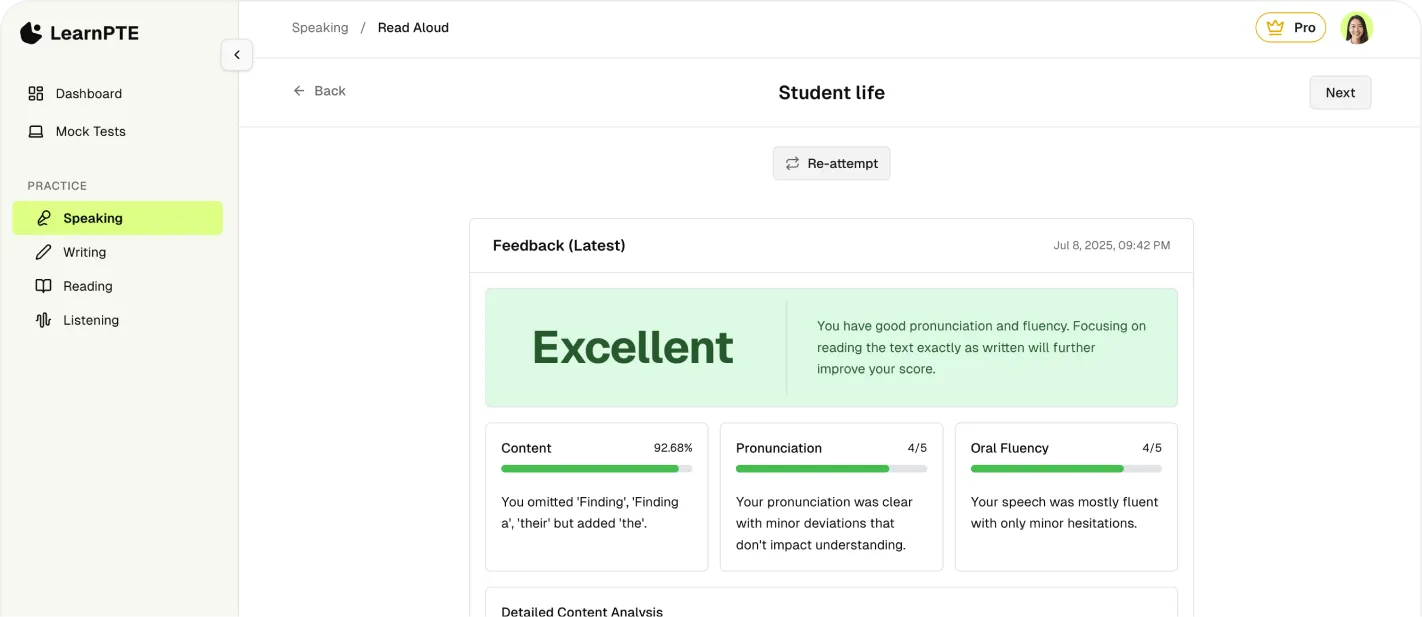
LearnPTE has a Respond to a Situation module with feedback on fluency, pronunciation and content. Try a free question.
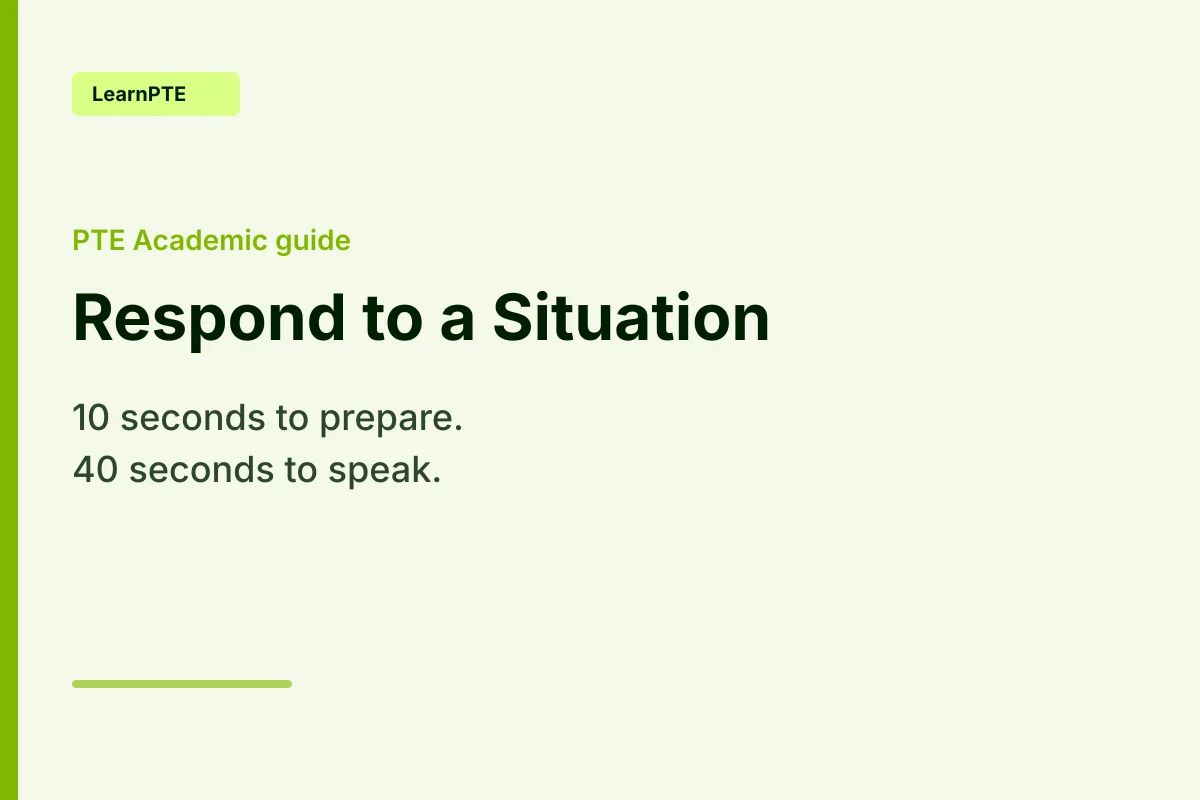
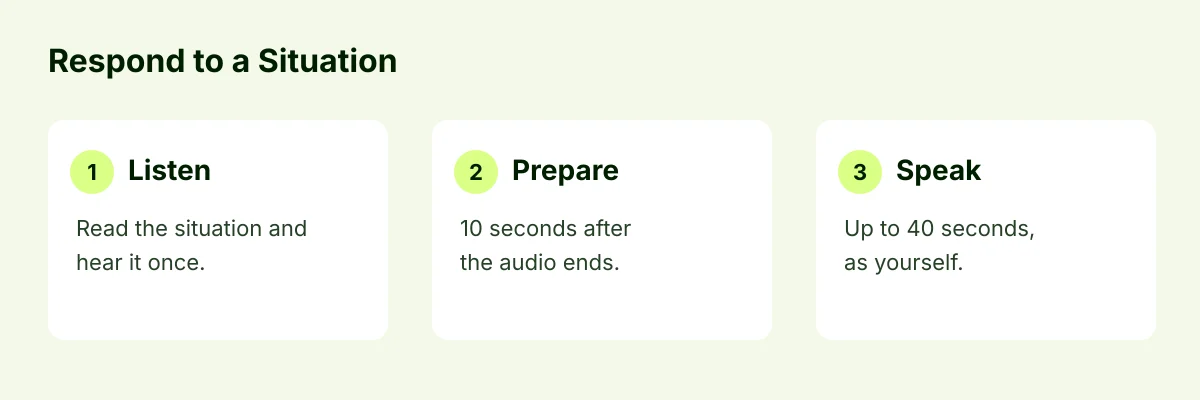
You see a short academic scenario, often involving a classmate, a lecturer or university staff, and you hear it as well. The audio plays once. After it ends you have 10 seconds to prepare and 40 seconds to speak. The speaking and writing format states those times, and so does Pearson’s February 2026 article. Do not use the 20-second preparation time from PTE Core.
You respond as yourself. "The student wants to ask..." is a summary of the prompt, which is not what the task asks for.
Pearson’s article says there is no single correct wording. A usable shape, which you still fill with the details of this prompt, is:
Start when the tone sounds. You have 40 seconds. Speak to the person in the prompt:
Match the opening to the person. A professor and a close classmate do not get the same first line. Pearson’s format page treats that fit as part of content: appropriate formal or informal language for the situation and the person.
State the reason in the prompt. Keep the details straight. If the prompt says Friday, do not say Sunday. The format page uses that exact kind of change as an example of misinterpreting the situation.
Say what you want to happen, in line with the goal.
The task is a spoken reply to a person on campus. Situation, person and goal are the three pieces Pearson’s own article tells you to find in the prompt.
— LearnPTE
The score guide (4 March 2026) scores three traits, all under Speaking:
| Trait | Score | Who reviews it |
|---|---|---|
| Content | 0–6 | Automated scoring, and a human reviewer. Content includes dealing with the situation and meeting its goal, which is where situational appropriacy sits. There is no separate Appropriacy trait on PTE Academic. |
| Pronunciation | 0–5 | Automated scoring only. Pearson’s 2025 updates say humans do not check pronunciation or fluency. |
| Oral fluency | 0–5 | Automated scoring only. |
The format page says content is about dealing with the situation and communicating clearly with appropriate expressions. No credit is given for no response or an irrelevant response. A memorised speech that does not fit this prompt is a content problem, because the response has to use the information you were given.
Oral fluency looks at rhythm and phrasing. Hesitations, repetitions and false starts lower it, as they do on other speaking items. That is separate from whether you met the goal.
The situation: You are working on a group project, but one teammate has not replied to any messages for a week. You decide to talk to your professor.
Your task: Speak to your professor, explain what has happened, and ask for advice on how to proceed.
This is an illustration of the shape above, not a score guarantee:
"Good morning, Professor. I'm sorry to bother you, but I'm looking for some advice on our group project. One teammate hasn't replied to any of our messages for over a week, and we're worried about the deadline. We've emailed and messaged them several times. Would you suggest we carry on as a smaller group, or is there a process we should follow? We want the project to stay on track. Thank you."
Easy things to avoid
Record a Respond to a Situation answer on LearnPTE. The module gives feedback on fluency, pronunciation and how relevant the content is. Try a free question.
Ten seconds to choose the tone and the goal. Forty seconds to say it, in the first person, with the prompt’s details intact.
— LearnPTE Team