LearnPTE
PTE GamesQuestion typesPTE ToolsCreate free accountTry a free question
PTE GamesQuestion typesPTE ToolsFeaturesBlog
Try a free questionCreate free account
Blog/Guides

PTE Summarise Spoken Text: Complete Guide with Templates & Strategies (2026)

November 15, 2025|17 min
LearnPTE Team
PTE Summarise Spoken Text: Complete Guide with Templates & Strategies (2026)

Read summarized version with

Loading content...

Make real PTE progress, faster

Practice for your PTE test with the most comprehensive and easy to use AI platform.
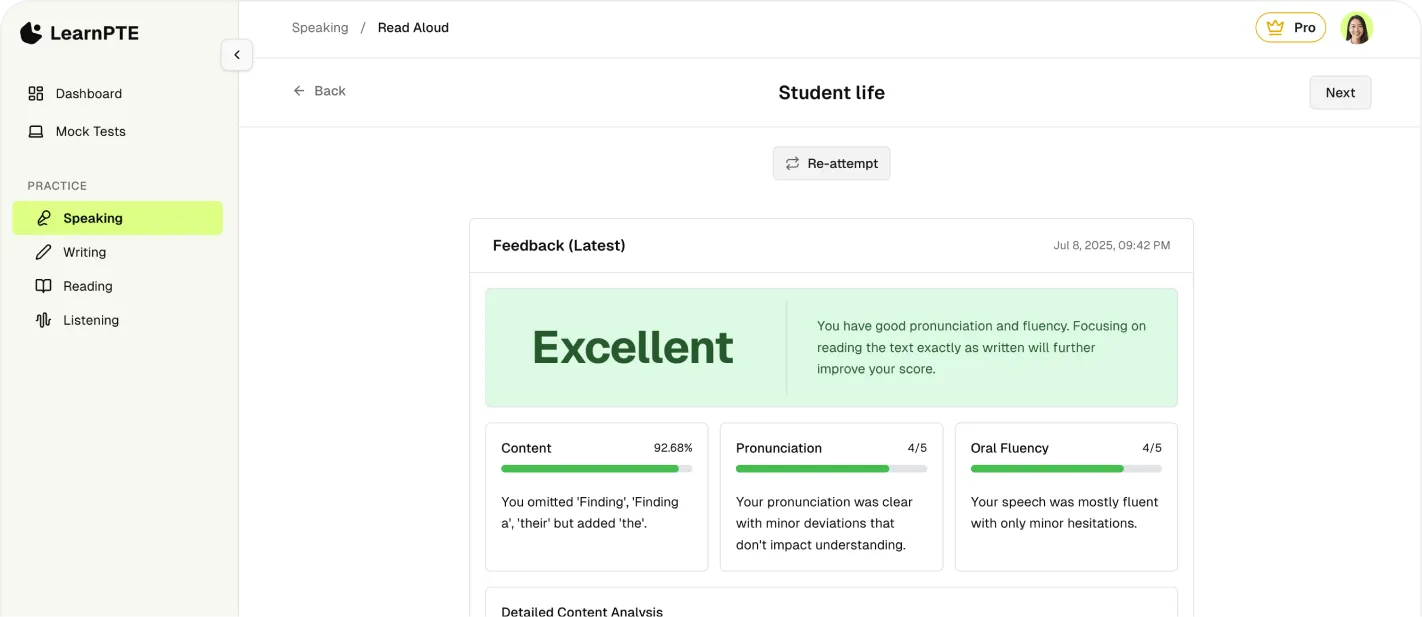
Try a free question
Try a free question Illustration
You might also like
Mastering PTE Write from Dictation: The Ultimate Scoring & Practice Guide
+2 more

Mastering PTE Write from Dictation: The Ultimate Scoring & Practice Guide

Discover the exact scoring mechanics, memory-training techniques, and time management hacks to ace the most critical task in PTE Academic.
By LearnPTE Team•10 min
Jul 01, 2026
Mastering the 2026 PTE Reading Section: Complete Guide to Overcoming Cognitive Fatigue
+3 more

Mastering the 2026 PTE Reading Section: Complete Guide to Overcoming Cognitive Fatigue

Discover why the PTE Reading module feels harder in 2026 and learn research-backed strategies to build mental stamina, master time management, and achieve your target score despite cognitive fatigue.
By LearnPTE Team•18 min
Apr 12, 2026
Focusing Through the Noise: A Practical Guide for 2026 Test-Takers
+1 more

Focusing Through the Noise: A Practical Guide for 2026 Test-Takers

How to stay focused in a busy PTE test centre, where other candidates are speaking at the same time, and what to do if the equipment fails.

By LearnPTE Team•11 min
Mar 20, 2026

LearnPTE is the smarter way to prepare for PTE. Practice real questions, get instant AI feedback, and improve faster with personalised insights.

© 2025 LearnPTE | Melbourne, Australia

General

  • Home
  • Pricing
  • Contact Us

Resources

  • PTE question types
  • PTE Tools
  • PTE essay practice
  • PTE Games
  • Features
  • Blogs
  • FAQs

Legal

  • Privacy Policy
  • Terms of Service

Summarise Spoken Text is one item. You hear a lecture of 60–90 seconds, played once, and write a summary in 10 minutes. Full Form credit is 50–70 words. The item contributes to Listening and Writing. Those facts are on Pearson’s listening format page, and the trait scores are in the test-taker score guide (4 March 2026).

Practise Summarise Spoken Text on LearnPTE. Try a free question.

What is the summarise spoken text task?

You listen to a short lecture, presentation or interview on an academic or general topic, then write a summary of the main points. The audio starts by itself and plays once. You may take notes.

Task format

Topics include science, technology, history, the environment, psychology, business and culture.

What stays the same:

  • One item on a test
  • 60–90 seconds of audio, played once
  • 10 minutes in total, including the time the audio is playing
  • 50–70 words for full Form credit
  • Listening and Writing both receive the score
  • The aim: the main points, in sentences, without adding your own opinion

The four-step strategy

Follow this four-step approach:

Step 1: Listen actively and take notes (1.5 minutes)

Prepare before the audio starts:

  • Ready your note-taking approach: Use abbreviations and symbols
  • Focus your attention: Eliminate distractions and concentrate fully
  • Listen for structure: Introduction, main points, conclusion

During listening:

  • Identify the main topic in the first 10-15 seconds
  • Note 3-5 key points using keywords only
  • Listen for transition signals: "however," "furthermore," "importantly"
  • Capture the conclusion or main takeaway
  • Don't try to write complete sentences—use shorthand

Pro tip: The first and last sentences usually contain the core message. Pay special attention to these crucial moments.

Step 2: Review and organise notes (1-2 minutes)

Immediately after the audio ends:

  • Review your notes while the content is fresh in memory
  • Identify the 3-4 most important points
  • Determine the logical relationship between ideas
  • Decide on the order for presenting points
  • Eliminate minor details or repeated information

Step 3: Write your summary (5-6 minutes)

Construct your paragraph:

  • Begin with the main topic or thesis
  • Present key supporting points in logical order
  • Use linking words to connect ideas smoothly
  • Paraphrase—don't rely on exact phrases from memory
  • Aim for 55-65 words for optimal safety margin
  • Write in complete, grammatically correct sentences

Step 4: Review and refine (2 minutes)

Check thoroughly for:

  • Word count (must be 50-70 words)
  • Grammar, subject-verb agreement, and verb tenses
  • Spelling accuracy (especially academic terms)
  • Logical flow and coherence
  • Capital letters and punctuation
  • Completeness of main ideas

Scoring breakdown

The item contributes to Listening and Writing. Pearson does not publish a split that says Content is the Listening score and Form is the Writing score. Five traits are scored, on the ranges in the score guide (4 March 2026).

TraitScoreWhat Pearson is looking at
Content0–4The main ideas, paraphrased. From 2025, Content is human-reviewed. A summary that misrepresents the topic or purpose can score 0 on every trait.
Form0–22 for 50–70 words. 1 for 40–49 or 71–100 words. 0 for fewer than 40 or more than 100, and also for all capitals, no punctuation, or only bullet points or very short sentences.
Grammar0–2Sentence structure, tense and punctuation a reader can follow.
Vocabulary0–2Word choice that fits the lecture.
Spelling0–22 if the spelling is correct, 1 for one error, 0 for more than one. Stay with one convention: British, American, Australian or Canadian.

Form 0 means the item is not scored. A summary of 40–49 or 71–100 words does not do that. It scores 1 for Form, and the other traits are still marked. Only Form 0, including a summary under 40 words or over 100, zeros the item.

Content. Include the main ideas and leave out anything the lecture did not say. Memorised or unoriginal responses can be treated as irrelevant and score 0. That has been part of the scoring since the 2025 updates, which also moved Content to 0–4 and added human review of Content. The 2025 change is that Content scale and the human review. It is not a new “integrated skills” label. This item already contributed to Listening and Writing.


Essential listening strategies

Active listening technique mastery

Pre-listening preparation (10 seconds):

  • Position your pencil and note-taking space
  • Clear your mind and focus entirely on the upcoming audio
  • Prepare to identify the topic immediately

During listening (60-90 seconds):

First 15 seconds—Identify the topic:

  • Listen carefully to the opening statement
  • Note the main subject or question being addressed
  • Write 2-3 keywords about the general topic

Middle section—Capture key points:

  • Listen for transition words: "firstly," "however," "in addition," "on the other hand"
  • Note 3-5 main supporting points or arguments
  • Don't get distracted by examples or minor details—focus on main ideas
  • Use symbols: arrows (→), plus signs (+), versus (vs), because (∵)

Final 15 seconds—Note the conclusion:

  • Pay special attention to concluding remarks
  • Listen for phrases like "in conclusion," "therefore," "ultimately"
  • Note the final takeaway or recommendation

Note-taking excellence

Effective abbreviation system:

  • Important → imp / govt → government / edu → education
  • Because → bc / with → w/ / without → w/o
  • Increase → ↑ / decrease → ↓ / leads to → →
  • And → & / example → e.g. / that is → i.e.
  • Technology → tech / development → dev / environment → env

Strategic note structure:

Topic: [Main subject in 2-3 words]

Key points:
1. [First main idea - keywords only]
2. [Second main idea]
3. [Third main idea]
4. [Fourth main idea if applicable]

Conclusion: [Final point or recommendation]

Pro tip: Don't write complete sentences while listening. Use minimal keywords that will trigger your memory when you write the summary. Speed and accuracy are more important than detailed notes.

Identifying main vs. minor information

Main ideas (include these):

  • The primary topic or thesis
  • Key arguments or explanations
  • Important causes or effects
  • Main conclusions or recommendations
  • Significant contrasts or comparisons

Minor details (exclude these):

  • Specific statistics or exact numbers (unless central to the point)
  • Detailed examples or anecdotes
  • Historical background unless it's the main focus
  • Speaker's personal experiences unless they're the core message
  • Repetitive information stated multiple ways

Essential writing strategies

Paragraph structure excellence

Opening sentence (12-18 words):

  • State the main topic of the lecture
  • Indicate the general purpose (explains, discusses, argues, describes)
  • Provide context for the key points

Example opening sentences:

  • "The lecture discusses the impact of climate change on Arctic ecosystems and the resulting environmental consequences."
  • "The speaker explains how artificial intelligence is transforming modern healthcare through enhanced diagnostic capabilities."
  • "The presentation examines the historical development of urban planning and its influence on contemporary cities."

Body sentences (30-45 words):

  • Present 3-4 key supporting points
  • Connect ideas logically using linking words
  • Maintain chronological or thematic order
  • Ensure each point relates to the main topic

Closing (optional, 5-10 words):

  • Brief conclusion or final point if word count permits
  • Not always necessary—prioritise main points

A flexible summary shape

If the notes feel messy, this shape can help you order them. It is a house outline. A memorised paragraph that does not follow the lecture can be treated as irrelevant and score 0, so replace every bracket with points from this recording.

The recording discusses [main topic], highlighting
[key point 1]. Furthermore, the speaker explains
that [key point 2], while also noting [key point 3].
Finally, the lecture suggests that [conclusion].

Sentence construction techniques

Complex sentence structures:

Structure 1 - Main idea with supporting points:

The lecture discusses (main topic), explaining that (point 1), highlighting (point 2), and noting that (point 3).

Structure 2 - Cause and effect:

The speaker explains how (cause) leads to (effect), which results in (consequence), ultimately affecting (final impact).

Structure 3 - Problem and solution:

The presentation addresses (problem) by proposing (solution) and emphasising (key consideration), while acknowledging (limitation).

Structure 4 - Comparative analysis:

The talk contrasts (concept A) with (concept B), arguing that while (point about A), (point about B) offers (advantage).

Linking words for coherence

For addition: and, furthermore, moreover, additionally, as well as, along with

For contrast: however, while, whereas, although, despite, yet, on the other hand

For cause-effect: because, since, as, therefore, consequently, thus, resulting in, leading to

For sequence: firstly, secondly, then, subsequently, finally, ultimately

For elaboration: explaining that, noting that, highlighting that, demonstrating that, suggesting that, emphasising that

Pro tip: Use linking words naturally to create flow. Aim for 3-4 linking words throughout your summary to ensure coherence.

Word count strategy

Optimal range: 55-65 words provides the sweet spot—sufficient to capture all main points while staying comfortably within limits.

What Pearson scores, and what is only a house tip:

  • 50–70 words: Form 2.
  • 40–49 or 71–100 words: Form 1. The item is still scored.
  • Under 40 or over 100: Form 0, and the item is not scored.
  • Around 55–65 words: a house target, not a Pearson band. It sits inside the full-credit range with a little room either side.

Myth Buster: More words ≠ Higher score

A 69-word summary is not worth more than a 55-word one. Both can score 2 for Form. Pushing to the edge of the range leaves more room for a grammar slip or a spelling error, and more than one spelling error scores 0 on that trait. A clear summary near 60 words is a safer house target than a cramped 69-word one.

Time management mastery

The 10-minute breakdown:

  • Minutes 0-1.5: Listen to audio and take notes
  • Minutes 1.5-3.5: Review notes, organise points, plan structure
  • Minutes 3.5-8.5: Write your summary (approximately 12 words per minute)
  • Minutes 8.5-10: Review for errors, check word count, refine clarity

Pro tip: If you finish early, use remaining time to enhance your vocabulary choices and check for grammatical errors. Every minute spent proofreading can prevent costly mistakes.


Sample audio topics with responses

Sample Audio: Customer Service Evolution

Listen to this 60-90 second lecture about customer service transformation. Take notes and practise writing your summary.

0:000:00

Click play to load audio

Audio Transcript (for reference):

"The transformation has been particularly dramatic in the digital age. Companies are discovering that customer service is no longer a cost centre, but a competitive differentiator driving revenue growth. Amazon's success largely stems from their obsessive focus on customer satisfaction, with their return policy becoming an industry benchmark. Traditional call centres are evolving into omnichannel support systems, where customers seamlessly transition between phone, chat, email, and social media interactions. Artificial intelligence is handling routine inquiries, allowing human agents to focus on complex problem-solving and relationship building. However, this technological shift requires careful balance. While chatbots can resolve simple issues instantly, customers still demand human interaction for sensitive matters. Training programmes now emphasise emotional intelligence alongside technical skills. Companies investing in comprehensive customer service training report 35% higher customer retention rates. The lifetime value calculation has changed how businesses view service interaction. A single negative experience can result in customers sharing their frustration across social platforms, potentially reaching thousands of prospects. Consequently, service recovery programmes are becoming increasingly sophisticated."

High-Scoring Response (64 words - Click to reveal)
The lecture discusses how customer service has transformed in the digital age, becoming a competitive differentiator rather than a cost centre, explaining that companies like Amazon demonstrate success through customer satisfaction focus, while traditional call centres evolve into omnichannel systems using artificial intelligence for routine inquiries and human agents for complex issues, noting that comprehensive training emphasising emotional intelligence leads to higher retention rates and sophisticated service recovery programmes.

Practise a similar summarise spoken text task

Try a free question

Why this works:

  • Captures main topic: customer service transformation in digital age
  • Includes key evolution: from cost centre to competitive differentiator
  • Lists major changes: omnichannel systems, AI integration, human balance
  • Mentions outcomes: higher retention rates, service recovery
  • Uses complex sentence with multiple clauses
  • Stays within optimal word count (64 words)
  • Grammatically correct with appropriate linking words

Advanced paraphrasing techniques

Instead of memorizing exact phrases:

When listening, you may hear:

  • "fundamental transformation" → significant change, major shift
  • "educational access" → learning opportunities, schooling availability
  • "digital divide" → technology gap, unequal access to technology
  • "sustainable practices" → environmentally-friendly methods, eco-conscious approaches
  • "unprecedented changes" → remarkable shifts, extraordinary developments

Synonym strategies for common academic terms:

  • demonstrates → shows, reveals, illustrates, indicates
  • significant → substantial, considerable, notable, important
  • enhance → improve, strengthen, boost, augment
  • implement → introduce, establish, adopt, execute
  • address → tackle, deal with, handle, confront
  • emphasise → stress, highlight, underscore, accentuate

Verb transformations:

  • "is transforming" → transforms, has changed, is changing
  • "has become" → represents, constitutes, emerged as
  • "are affecting" → impact, influence, alter
  • "contributes to" → leads to, results in, causes

Noun to verb conversions:

  • Original: "the implementation of new strategies"
  • Paraphrased: "implementing new strategies"
  • Original: "the development of technology"
  • Paraphrased: "technology develops" or "developing technology"

Pro tip: Focus on capturing the meaning rather than exact wording. The audio plays only once, so you're summarising from notes anyway—natural paraphrasing should come automatically.


Common mistakes to avoid

Content Mistakes ❌

  • Missing main ideas because you focused on minor details
  • Including information you're unsure about rather than leaving it out
  • Adding your own opinions or interpretations not in the audio
  • Misrepresenting the speaker's message or arguments
  • Trying to include every point instead of the most important ones
  • Getting distracted by difficult vocabulary and missing subsequent points

Form mistakes

  • Going under 40 words or over 100, which scores 0 for Form and means the item is not scored
  • Landing on 40–49 or 71–100 and taking Form 1 when 50–70 was available
  • Using bullet points, or writing only very short sentences, which Pearson scores 0 for Form
  • Leaving the word counter unchecked

Several short paragraphs are not, by themselves, a published reason for Form 0. Bullet points and a string of very short sentences are. One clear paragraph is the safer shape.

Listening Mistakes ❌

  • Trying to write complete sentences during listening
  • Panicking when you don't understand specific words
  • Not using abbreviations, leading to incomplete notes
  • Focusing too much on examples rather than main points
  • Missing the conclusion because you're still writing earlier points
  • Not preparing mentally before the audio starts

Grammar Mistakes ❌

  • Subject-verb agreement. House tip: in academic writing, "data" is often plural, so "the data show" is the safer form. That is not a separate line in the score guide.
  • Inconsistent verb tenses (switching between past and present)
  • Run-on sentences without proper punctuation
  • Sentence fragments or incomplete sentences
  • Incorrect use of articles (a, an, the)
  • Missing commas in complex sentences

Vocabulary Mistakes ❌

  • Using informal or casual language
  • Repetitive word choice without synonyms
  • Misusing academic vocabulary
  • Spelling errors in common academic terms
  • Inappropriate or imprecise terminology

Time Management Mistakes ❌

  • Spending too much time organising notes (over 2 minutes)
  • Starting to write before reviewing and organising notes
  • Not leaving time to proofread (less than 1 minute for review)
  • Rushing through writing and making careless errors
  • Not monitoring word count during writing

Note-Taking Mistakes ❌

  • Writing too much detail and missing subsequent points
  • Not using any abbreviation system
  • Organising notes in a confusing way
  • Not marking which points are most important
  • Forgetting to note the main topic clearly

What changed in 2025

For tests taken after 7 August 2025, Pearson expanded Content to 0–4 and added human review of Content. The other traits were not renamed, and the item was not newly classified as an integrated-skills task. It already contributes to Listening and Writing, as a whole item, not as “Content equals Listening” and “Form equals Writing”.

Memorised or unoriginal responses can be treated as irrelevant and score 0. A sentence shape can help you order the notes. The summary still has to follow the lecture you just heard.

What to do with that:

  • Note the main point and the essential support, not a transcript.
  • Paraphrase from the notes. Content looks for the ideas, and it is now the widest trait.
  • Stay inside 50–70 words if you want Form 2. Form 1 is still a scored response.
  • Check spelling once. More than one error scores 0 on spelling.

Self-evaluation checklist

After each practice summary, ask yourself:

Listening & Content:

  • Did I identify the main topic accurately?
  • Have I included 3-4 key supporting points?
  • Did I exclude minor details and specific examples?
  • Does my summary accurately represent what I heard?
  • Have I avoided adding my own opinions?
  • Did my note-taking strategy work effectively?

Form:

  • Is my response between 50-70 words (ideally 55-65)?
  • Did I write in proper paragraph format?
  • Have I written sentences with punctuation, rather than bullet points or a string of very short sentences?

Grammar:

  • Are all sentences grammatically correct?
  • Did I use complex sentence structures?
  • Are verb tenses consistent and appropriate?
  • Is subject-verb agreement correct throughout?
  • Have I used punctuation correctly?

Vocabulary:

  • Have I paraphrased rather than using exact phrases from memory?
  • Is my word choice appropriate and precise?
  • Have I used academic, formal language?
  • Did I avoid repetition with varied vocabulary?
  • Have I used linking words effectively?

Spelling:

  • Have I checked spelling of all academic terms?
  • Are common words spelled correctly?
  • Have I maintained consistency (US or UK English)?

Content is 0–4 and human-reviewed. Form is still 2, 1 or 0 depending on the word count, and Form 0 means the item is not scored.


Frequently asked questions


Practise from one listening

There is one Summarise Spoken Text item, and the audio plays once. Take short notes, then write 50–70 words in full sentences. Leave a minute for the word counter, one spelling pass, and a capital at the start of each sentence.

The notes only need to restart the main ideas. The summary has to be sentences, inside the word range, in your own wording.

— LearnPTE

Listen once and write the summary on LearnPTE. Try a free question.